
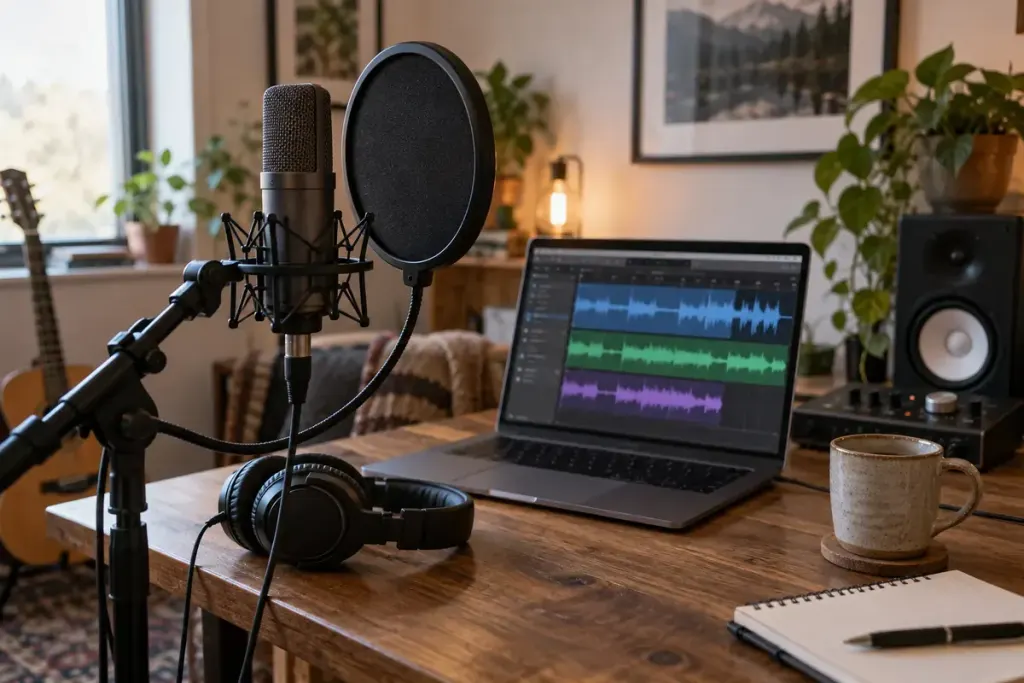
An audio compressor can reduce differences between louder and quieter parts of a recording. It is easy to hear “more consistent” and assume that turning it up is always helpful. With speech, too much processing can make breaths, room noise and changes of emphasis unexpectedly prominent.
Start with two controls: threshold and ratio. The threshold marks the level above which compression acts in a simplified model. The ratio describes how much an increase above that point is reduced. The Audacity compressor manual explains these controls alongside timing and gain settings; the whole result depends on more than the ratio alone.
Work through one number
Imagine a hard-knee compressor with a threshold of −18 dB, a ratio of 3:1 and no makeup gain. A sustained input level of −9 dB is nine decibels above the threshold. At 3:1, that excess becomes three decibels. The simplified output is therefore −15 dB.
This calculation describes a static level relationship. It does not predict every moment of a real spoken word. Attack, release, knee and the detector’s behaviour affect how the processor responds as the signal changes. A short consonant may not behave like a sustained test level.
Use a sentence with contrast
Make an original practice recording: “I left the parcel beside the door, not inside the cupboard.” Say it naturally, with one word emphasised. Keep an untouched copy. Apply a modest setting to a duplicate, then listen for the beginning of words, the end of phrases and the breath between them.
Compare at similar perceived playback loudness. If the processed copy is simply louder, that difference can dominate your judgement. Listen for intelligibility and natural emphasis rather than the size of the waveform.
- If a breath suddenly distracts you, check gain and the amount of reduction.
- If a word loses its initial impact, examine timing controls rather than changing every setting together.
- If the room seems to swell during pauses, listen to the recording conditions and gain behaviour before adding more processing.
Know what compression cannot repair
A compressor does not turn a clipped recording into an undamaged one, remove the room from the voice, or replace careful microphone placement. Sometimes a small manual level adjustment to one phrase is the clearer solution.
Save a note of the settings and the reason you kept them. “The final clause remains audible without flattening the stressed word” is a useful verdict. “Ratio 3:1 is best for podcasts” is a claim the exercise never tested.
AI-generated editorial illustration; not a documentary photograph.